
Issue 50: A Mini-Tutorial on Program Monitoring and Evaluation
How to Evaluate the Effectiveness of Your Human Rights Due Diligence Program.

I first learned the fundamentals of monitoring and evaluation, often referred to as M&E, while working at the U.S. State Department. As a Grant Officer, I was responsible for developing Requests for Proposals (RFPs), managing project solicitations, and overseeing funded programs around the world.
In that role, every project proposal needed clear goals, defined outputs, expected outcomes, and a way to measure whether the work was actually producing results. External evaluations were often built into the program design by the grantee.
When I left government and joined Disney, one of my first responsibilities was to help build an innovative responsible sourcing program from the ground up. I brought that same M&E mindset with me. I understood the basic anatomy of how programs should be structured and evaluated from start to finish.
At Disney, I built every element of the Supply Chain Investment Program (SCIP), from the overall strategy to the monitoring and evaluation framework. Once the program launched, I spent significant time raising awareness about the initiative and training colleagues on the fundamentals of M&E. Their participation was essential for local project monitoring and engagement with grantees.
For many colleagues, these concepts were entirely new. We spent time walking through the basics together, including the difference between inputs, outputs, outcomes, and impact. For many teams, this way of thinking about program effectiveness was unfamiliar, but it was critical to ensuring that the program could demonstrate real results over time.
Today, as corporate human rights programs face increasing expectations from regulators and stakeholders, the ability to measure outcomes is becoming essential.
I am not a monitoring and evaluation expert in the traditional sense, but I understand the discipline and know what elements are most useful for companies evaluating human rights programs. Corporate programs often operate on shorter timelines than international development initiatives, and leadership typically wants to understand what progress has been made within a 12-month period.
My goal is to keep M&E simple, practical, and actionable. This should not be an academic exercise.
In this article, I will walk through how companies can begin building this capability and share my six non-negotiables for corporate HRDD monitoring and evaluation.
We will cover:
• What monitoring and evaluation actually means in HRDD
• How companies can build the foundations for this work
• The non-negotiables every HRDD program must have
• Tools and frameworks that can help companies put this into practice
Can You Answer This Simple Question?
Over the past twenty years, I have helped design corporate human rights programs across different industries.
I have seen companies invest enormous energy in policies, supplier codes of conduct, audits, and reporting frameworks.
But one question consistently reveals whether a program is truly working:
Is our program improving the lives and working conditions for global supply chain workers?
If the answer is unclear, the company does not really have a functioning human rights due diligence program. It has documentation, reporting, and projects.
That question sits at the heart of monitoring and evaluation or M&E. In my opinion, it is the missing backbone of many corporate human rights programs.
Human Rights Due Diligence (HRDD) is not a single activity or project. It is an ongoing process. There is no finish line. The goal is not to complete HRDD. The goal is to continuously improve how a company prevents harm and responds when harm occurs.
To do that effectively, companies need systems that help them understand whether their actions are actually making a difference.
This is where monitoring and evaluation becomes essential.
For many years, M&E was primarily associated with the international development sector. Governments, foundations, and NGOs used it to measure the effectiveness of funded programs and demonstrate accountability for public or donor resources.
Today, the same discipline is becoming increasingly important for companies. As expectations around corporate human rights responsibility grow, stakeholders want to understand not only what companies say they are doing, but whether their actions are producing real results.
This shift is accelerating as new regulations come into force, including the EU Forced Labor Regulation (2027) and the EU Corporate Sustainability Due Diligence Directive (2029). Regulators, investors, civil society organizations, and enforcement authorities will increasingly look for evidence that corporate human rights programs are effective.
In other words, companies will need credible systems to track performance and demonstrate impact.
A simple way to think about a monitoring and evaluation framework is this progression:
Strategy → Objectives → Outcomes → KPIs → Data → Evaluation → Learning
Each step builds on the one before it and helps translate corporate commitments into evidence.
Without that structure, companies can easily become busy without knowing whether their efforts are actually improving conditions for workers.
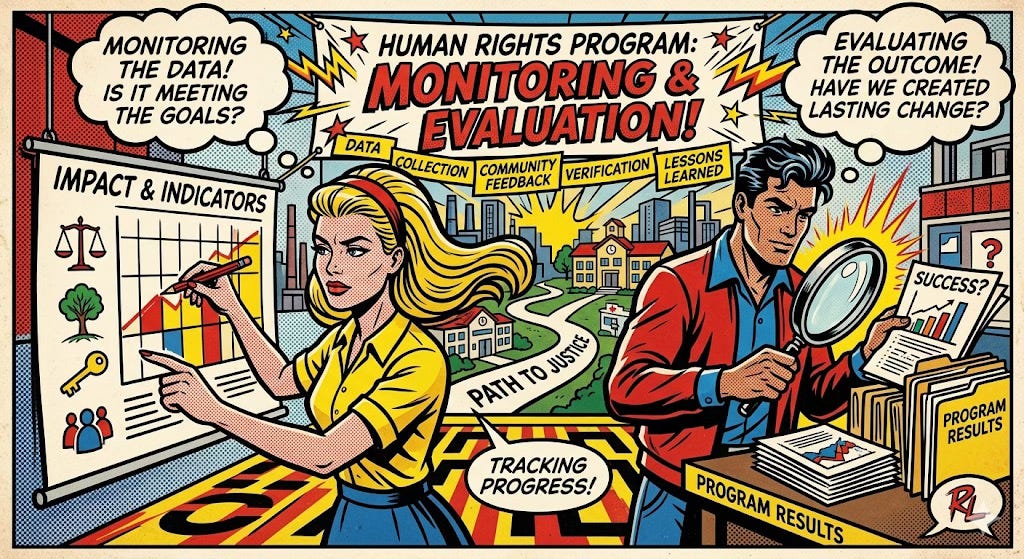
KPIs Are a Critical Building Block of Any M&E Program
If you work in corporate human rights, you are probably very familiar with KPIs. As practitioners, we create them, refine them, and report them to leadership regularly.
Most teams also collect large amounts of data. Dashboards get built, numbers get tracked, and reports get generated. We know how many audits were conducted, how many suppliers were engaged, and how many non-compliance issues were identified or remediated.
But metrics alone cannot tell us whether a program is improving conditions for workers.
KPIs matter because they provide measurable evidence that a program is progressing. They help leadership track performance, allocate resources, and demonstrate that commitments are being implemented. But KPIs only become meaningful when they are connected to clear goals and outcomes.
Before defining KPIs, companies should step back and answer three simple questions:
What are we trying to change?
What risks are we trying to reduce?
What should be different for workers if the program is working?
Three elements should be clear before KPIs are developed:
Corporate human rights goals
Expected outcomes
The specific changes we want to see for workers
Without these foundations, KPIs can easily become numbers on a dashboard rather than indicators of impact.
Many programs end up tracking metrics such as:
Number of audits conducted
Number of suppliers trained
Number of policies issued
Number of risk assessments completed
These indicators show effort. They demonstrate that activity is happening. But they do not tell us whether conditions for workers are improving.
Audits can increase while risks stay the same. Suppliers can attend training without changing their practices. Policies can exist without affecting what happens on the ground.
Activity is not the same as impact.
The strongest human rights programs start with a different question:
If our human rights due diligence program is successful, what should be different for workers?
For example:
Migrant workers do not pay recruitment fees
Workers have safe channels to report abuse
Excessive overtime declines
Wage theft is identified and remedied
Once these outcomes are defined, KPIs become far more meaningful. Activity metrics such as audits and training still matter, but they now support a broader goal and help demonstrate progress.
My Experience
During my time at Marriott, I helped develop the company’s first public sustainability and social impact goals called Serve 360. The framework included four focus areas. I was responsible for the Welcome All and Advance Human Rights pillars, which addressed human trafficking risks and integrated human rights considerations across global operations.
As part of this work, we needed clear KPIs.
One indicator focused on employee awareness and training. In a global hospitality company like Marriott, associates are often the first line of defense in identifying potential human trafficking situations.
The KPI we established was straightforward:
100 percent of on-property associates will complete human rights training by 2025, including training on human trafficking awareness, responsible sourcing, and ethical recruitment practices.
This KPI worked because it was specific, measurable, and tied to a clear objective. It ensured employees understood how to identify risks and respond appropriately. It also allowed leadership to track progress globally and demonstrate how the company was operationalizing its commitments.
A New Resource for the Tech Sector
New guidance is also emerging to help companies develop stronger KPIs.
Recently, Article One and Steptoe released new guidance for the technology sector. The report identifies thirteen salient human rights risks in the industry, outlines actions companies can take to address them, and shows how those actions can be translated into measurable KPIs.
This type of guidance is especially useful because many technology companies are still early in operationalizing HRDD or at different maturity levels. It will be interesting to see how companies use this framework to develop more meaningful KPIs and build systems that track whether their human rights programs are actually working.
At the end of the day, monitoring and evaluation is not about dashboards.
It is about understanding whether our actions are improving people’s lives.
What Monitoring and Evaluation Means in Human Rights Due Diligence
When people hear the term Monitoring and Evaluation, or M&E, it can sound technical or overwhelming. In reality, it answers a very practical question for companies implementing Human Rights Due Diligence (HRDD).
Is what we are doing actually working?
Under the UN Guiding Principles on Business and Human Rights (UNGPs), companies are expected to track the effectiveness of their responses to human rights risks and impacts. That expectation is built directly into the due diligence process.
But this requirement may often be misunderstood.
Tracking effectiveness does not mean documenting activities. It means understanding whether those activities are producing meaningful results.